
Character Snapshot: Simon Peter
Disciple and Martyr?

We are not entirely sure who all of Jesus’ initial followers were, but there is good reason to believe that one of them was a man by the name of Simon Peter. This passionate disciple was said to have walked on water, to have denied Jesus at a crucial moment, and according to tradition was one of the pillars of the early Christian Church. But how much of this information can we be confident in? And are other traditional claims about Peter historically probable? For instance, did he write some of the texts in our New Testament? Was he martyred? And where do these claims originate? In an attempt to address some of these questions, this Character Snapshot will examine one of Jesus’ closest disciples. So, who was Simon Peter?
Simon Peter in the Canonical Gospels
Simon is given the name or title “Peter” by Jesus, a word derived from a koine Greek word meaning “rock”, which appears in different ways throughout the New Testament. Sometimes, like in Mark 3:16, it is the Greek Πέτρον or as in Matthew 16:18 Πέτρος (Peter). Other times it is a Greek version of the Aramaic Κεφᾶς (often appearing in New Testaments as “Cephas”). Both differ from another Greek word λίθος meaning “stone”, from which we get our modern English words like “Paleolithic” (old stone), “lithosphere” (the rocky outer edge of earth’s surface), and “Megalith” (a large stone structure). Πέτρον/Πέτρος and Κεφᾶς are used exclusively as titles or names. In the Gospel of Mark, Jesus gives Simon the title of Peter, but we are not told why. Later Gospels, like Matthew, link it to Peter’s claims about Jesus as the Messiah and Peter’s role as a foundational “rock” of the early Church.
In our best surviving sources, Peter is portrayed as a lower-class Jew living in Capernaum, a town along the Sea of Galilee. In all of the Synoptic Gospels, he is described as a fisherman (this is not as clear in the Gospel of John). Like nearly all people who engaged in manual labor in the ancient world, this likely meant that he was illiterate and was accustomed to long days, meager wages, and harsh taxation. This is a generalization, of course, which Peter may not fit into, but I don’t think we have good reason to doubt it. That he was illiterate says nothing about his intelligence, only that he had not been trained to read and write, just like nearly every person living in the ancient world. Perhaps he could have read a little, but only what would have been needed for his work. I highly doubt that he would have known what to do if he’d been handed the Homeric Epics, let alone write sophisticated literature or letters of his own.1 As was common for Jews of his day and geographic location, his primary language would have been Aramaic. The Gospel portrayals of his profession and location allow us to draw many of these conclusions.
The way he is depicted in the Gospels varies slightly depending upon which Gospel we are reading, but he is consistently represented as a passionate disciple of Jesus and part of Jesus’ inner circle of followers along with John and James. His boldness and self-confidence are often on display. In the Gospel of John, he is depicted as the one who cut off the ear of the slave of the High Priest (John 18:10) and in all of the canonical Gospels he denies knowing Jesus at all during the trial scenes, despite previous assurances that he would not do so. The Gospel of John gives us the clearest indications that Peter was forgiven his failures and given the task of continuing Jesus’ mission (John 21), giving Peter’s story a redemptive quality.
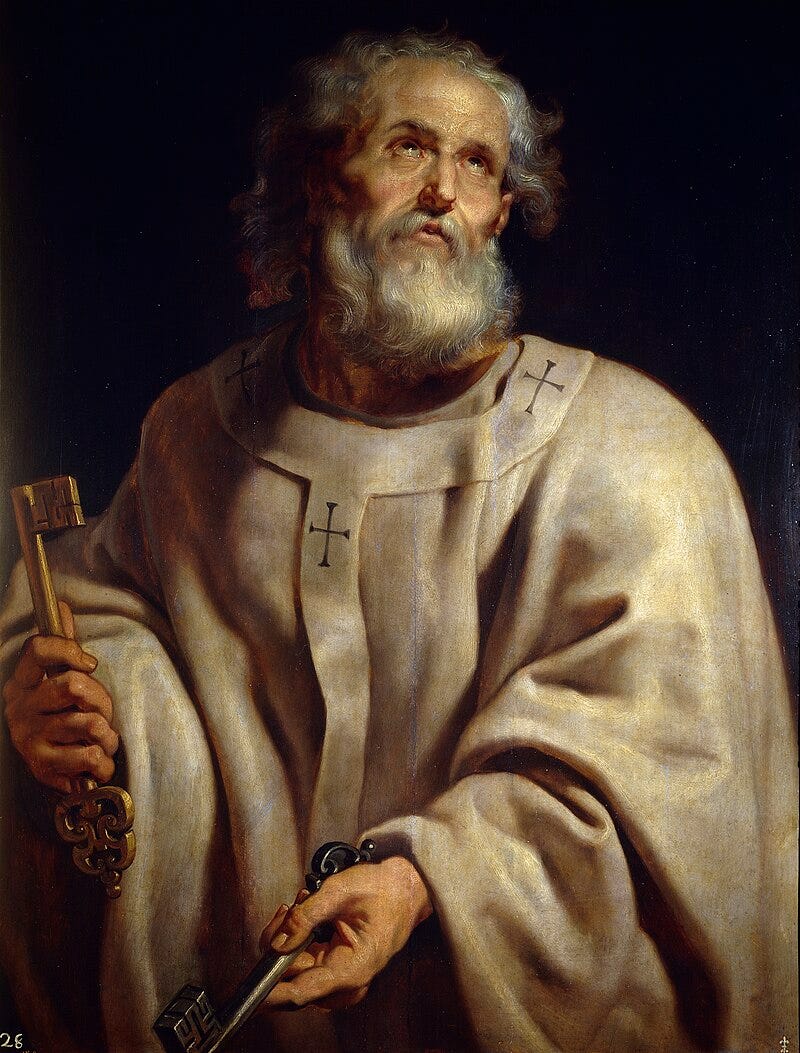
-Saint Peter in Papal Vestments by Peter Paul Rubens. Source: By Peter Paul Rubens - originally uploaded to en.wikipedia by Wlkernan (talk · contribs) on 14 May 2005 under the file name Pope-peter pprubens.jpg.(+/−), Public Domain, https://commons.wikimedia.org/w/index.php?curid=303203.
Peter Outside of the Gospels
Peter is well attested as far as ancient figures go. While the names of most of Jesus’ initial disciples are likely later creations of the early Church,2 I think we can be pretty confident that a real person named Peter was one of Jesus’ earliest disciples. There are several different places that he appears in early Christian literature, as well as a few texts which claim to be written by him. So, let’s take a brief look at some examples:
The Letters of the Apostle Paul (c. 50s CE)
-Paul mentions Peter in Galatians (1:18, 2:7-14) as well as in 1 Corinthians (1:12, 3:22, 15:5) and describes spending time with him and getting into fiery debates about dietary laws. In 1 Corinthians, Paul gives some intriguing descriptions of divisions within communities of early Jesus followers over whose teachings to follow—Paul’s, Peter’s, or Apollos’—which seems to indicate that Peter attracted a decent following around his interpretation of Jesus’ message.
1 Clement3 (c. late 1st century CE)
-This letter, written from the congregation of Rome to the congregation of Corinth, mentions Peter as a “good Apostle” and potentially alludes to his death as a martyr.
The Writings of Papias (c. early 2nd century CE)
-The Church historian Eusebius preserves the writings of the bishop Papias, who claimed that someone named Mark interpreted and wrote down the recollections of Peter concerning Jesus. This has led some to conclude that the Gospel of Mark is essentially the work of Peter, though most critical scholars are skeptical of this. I wrote on this subject in a previous post on the Gospel of Mark.
Acts of the Apostles (c. early 2nd century CE)
-Peter features prominently in the Acts of the Apostles, particularly in the first half of the text. He is portrayed as a leader in the early Jesus Movement, as well as someone who performs miracles (Acts 3 and Acts 5), and is the conduit for divine punishment (Acts 5). Nothing is said of his later life or death in this text.
The Writings of Tertullian (late 2nd-early 3rd centuries CE)
-The early Church theologian Tertullian mentioned Peter on several occasions throughout his prolific writing career. He says that Peter was crucified in Rome, confirms that he was a “rock” of the early Church, and that Clement of Rome received his authority from Peter, giving an indication of apostolic succession4 in the early Church.
Acts of Peter (c. late 2nd century CE)
-In this text, Peter performs many miracles and brings people to faith in Jesus. He is depicted as having a wife and a daughter, the latter of whom suffers from paralysis. He chooses not to heal her so that men will not want to have sex with her, and she can thus avoid “defiling” herself. Near the end of this text, Peter gets into trouble with Roman authorities and is crucified upside down.
Apocalypse of Peter (c. late 2nd century CE)
-While the title of this text bears Peter’s name, it is widely considered to be pseudonymous.5 In this story, Peter experiences visions of the heavenly afterlife and gruesome scenes of divine judgment. In some versions of this story, Peter discovers that those condemned to the torments of hell will eventually be redeemed through the prayers of the righteous, a rare hint of universalism6 in early Christianity.
Gospel of Peter (c. late 2nd century CE)
-This is yet another text attributed to Peter which scholars believe is pseudonymous. However, it provides some interesting perspectives about Jesus’ final hours and resurrection, and includes a giant talking cross which emerges from Jesus’ tomb!
Conclusion
There is a good deal of material about the character of Simon Peter, some of which I think we can trust historically and much of which I tend to think is quite detached from historical reality. I think it is clear, for example, that sometime in the first century a story about Peter’s martyrdom7 via crucifixion arose which was perpetuated and further developed in later textual traditions.8 But did this tradition develop in the middle of the 1st century closer to when Peter supposedly died, or towards the end of the 1st century when we first see it appear in our written record? Are texts like the Acts of Peter and the letters of Tertullian capturing what really happened, or simply perpetuating stories which arose about this pivotal figure? These are the types of questions these sources cause us to ask, and I tend to be more skeptical that most of these sources are giving us historical recollections, nor am I convinced that’s what they were trying to do in every circumstance.
What we can glean from some of these portrayals of Peter, in my opinion, is a deeper understanding of what mattered to the early Christian movement and how they chose to remember pillars of their faith like Peter. In a way, some of the texts we’ve looked at today are a type of fan fiction, written by members of the Christian community who were seeking to make positive statements about a prominent member of the early Jesus Movement and codify apostolic authority in the developing institution of the Church. In doing so, these writings serve to further develop Peter as a character and expand the mythos and ecclesiastical structure9 of early Christianity.
Reading Suggestions:
-The Gospel of Peter: Introduction, Critical Edition and Commentary by Paul Foster
-Acts of Peter (can be accessed via Internet Archive)
-The Apocryphal Acts of the Apostles : An Introduction by Hans-Josef Klauck
Most critical scholars, myself included, do not think that Peter authored 1 and 2 Peter. These texts are widely believed to have been written in Greek (a language Peter likely didn’t know well) and were not composed until sometime in the 2nd century well after Peter’s lifetime.
I suggest this because the Apostle Paul only mentions names two followers of Jesus who also appear as disciples in the Gospels—Peter and John. He also mentions James, Jesus’ brother and references “the twelve” but does not give their names.
This letter is often attributed to Clement of Rome whom early patristics like Irenaeus (living middle of 2nd century CE) describe as the bishop of Rome in the late first century. The letter itself, however, does not claim sole authorship from Clement, and most scholars doubt whether the Christian Church was ecclesiastically developed enough by the late first century CE to have bishops.
This is the idea that authority and “proper” theology were passed down from the earliest apostles like Peter through a line of bishops and popes. This idea is particularly common in the Catholic Church.
This is a term used to describe “false names” given to texts. This was fairly common in early Christianity, even with texts that made it into the New Testament canon.
This refers to the theological position that all of humanity will be saved through Jesus’ salvific work and avoid eternal torment.
For a deeper look at persecution and martyrdom of early Christians, see Candida Moss. The Myth of Persecution: How Early Christians Invented a Story of Martyrdom. New York: HarperOne, 2013.
We even see this alluded to in the Gospel of John (chapter 21).
Referring to the theological and institutional structure of the Christian Church.