
Character Snapshot: Tertius
The Man Who Wrote the Letter to the Romans

The Letter to the Romans may be the most influential text in the history of Christianity. Attributed to the Apostle Paul, it has been pored over by countless scholars and laypersons alike who have grappled with the social, political, and theological implications of its author’s words. Often lost in the minutiae of the text and the sweeping statements about Jesus and God’s redemptive plan for humanity is a single verse near the end of the letter: “I Tertius, the writer of this letter, greet you in the Lord.” Who was Tertius?
Writing in the Ancient Mediterranean World
Writing is a very recent technological phenomenon, at least when compared with the history of our species. Emerging roughly 5,000 years ago in Mesopotamia, it was first used to document business transactions and record exchanges of goods. These earliest texts were written in Cuneiform and were generally constructed by making indentations in wet clay tablets which could then be dried and preserved. Writing arose independently in other places around the world in the following millennia, eventually evolving to include alphabets and becoming so ubiquitous that most people on the planet today are able to write and read.
But in the ancient Mediterranean world, this was not the case. Our best estimates for literacy in the first century Roman Empire, for instance, are between 10-15%. Imagine living in a world where only 10 out of every 100 people you knew could read and write. How would this make us think about the written word or the people who could produce it? Writing was one part of an educational system in the Greco-Roman world. In general, there were three primary stages of the educational process. The first stage normally occurred at home or under the supervision of a teacher of letters where students began learning to read and write. For many, this is where their education ended, but for some, they continued under the tutelage of a teacher of language and literature, someone who guided them through the reading, copying, and interpretation of passages from the likes of Homer, Euripides, and other great poets and thinkers from the past.1 An even smaller demographic would be trained in rhetoric and philosophy.
It may be tempting to imagine that the producers of our ancient texts were sophisticated elites, and in many ways this may have been true. Although as Candida Moss notes in her book God’s Ghostwriters, one could belong to the “literate elite” without belonging to the “social elite”.2 The Letter to the Romans provides us a small window into this reality.
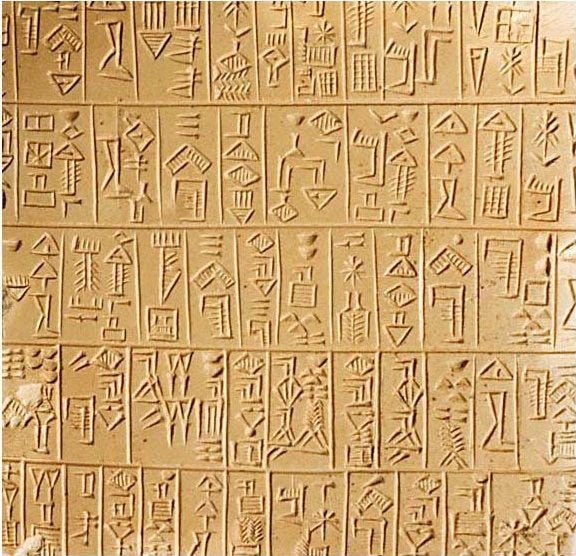
-A Sumerian inscription in monumental archaic style, c. 26th century BC. Source: By Unknown author - http://www.schoyencollection.com/religions_files/ms3029.jpg, Public Domain, https://commons.wikimedia.org/w/index.php?curid=660521.
Tertius, Scribe and Slave?
We now have countless paintings and depictions of the gospel authors and the Apostle Paul sitting at desks with quills in hand, scribbling away at parchment in solitary productions of our New Testament texts. And while we may recognize on some level that these are anachronistic, the image sticks in our minds so much that when we read a letter of Paul’s, our first inclination is to picture something akin to those paintings.
But in the ancient world, letters and texts were usually dictated by one person and then written by someone else. So, a better way to imagine this would be to picture Paul walking around a room—or sitting in prison as he often did—speaking aloud while one, or perhaps several, people wrote his words as they heard them. Writing was an expensive and difficult task, quite different from me sitting here on a comfortable chair and pressing buttons, and those in need of producing texts would often utilize the labor of others in this process. To return to Moss’s distinction between literary and cultural elites, there is a growing body of evidence to suggest that slaves were often trained to read and write in order to be used in the production of texts.
I do think it is worth noting that it appears that most of Paul’s surviving letters were dictated. He makes a point to mention when he is writing with his own hand (1 Corinthians 16:21, Galatians 6:11), suggesting the rest of those letters were not written by his own hand. But, it is only in the letter to the Romans that the one writing the letter makes themselves known. Normally, the identity of the scribe is suppressed, making Romans a fascinating anomaly.
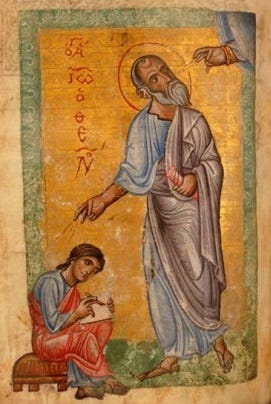
-A depiction of the writing process showing heavenly direction, authorial dictation, and scribal activity. Source: https://readingacts.com/2016/09/12/who-was-tertius-romans-1622/.
So, our guiding question about Tertius reemerges here. Discovering who this person was begins with what he tells us about himself in his own hand. He penned the original letter to the Jesus followers in Rome. While we would like to have more information, we may have enough to conclude that he was a slave. That does not necessarily mean that he was enslaved to Paul, but instead was likely in temporary service to him. It seems a similar situation may have occurred with the slave Onesimus who is the subject of Paul’s letter to Philemon. Moss notes that Tertius is traditionally associated with the household of Phoebe, a prominent member of a community of Jesus followers in Corinth where most scholars believe Paul wrote Romans from. Tertius clearly was trained to write and this may have been common for household slaves of wealthy families. The fact that he sends greetings to those in Rome may also suggest that he had ties to the community of Jesus followers there. One last sign that he was a slave comes from his name which is derived from the Latin word for three. It was common in the ancient world for slave owners to name their slaves with numbers.
In later Christian traditions, Tertius was said to have become a bishop and to have died as a martyr. While these traditions lack historical probability, Tertius has become a relatively prominent figure in some contemporary Christian traditions, such as the Orthodox Church, and has feast days attributed to him in October and November.
Conclusion
I think one of the most fascinating takeaways from this topic is the collaborative nature of our New Testament texts. Multiple people were involved in the creation of these documents. Might scribes like Tertius have given their input or made suggestions to those like Paul? And if so, might we be reading the thoughts and perspectives of multiple people, even enslaved individuals, when reading the letter to the Romans? Secondly, the character of Tertius brings some uncomfortable realities to the forefront, reminding us of the ubiquity of slavery in the ancient world and the likelihood that slaves played a very intimate role in the production of the New Testament.
Reading Suggestions:
-God’s Ghostwriters: Enslaved Christians and the Making of the Bible by Candida Moss
-Ancient Enslaved Christians, https://www.ancientenslavedchristians.org/about-6. This is an online database that is consistently updated which details slavery in its early Christian contexts.
Matthew Ryan Hauge, and Christopher W. Skinner. Character Studies and the Gospel of Mark. Vol. 00483. T&T Clark, 2014. EBSCOhost. 59.
See Candida Moss. God’s Ghostwriters: Enslaved Christians and the Making of the Bible. New York: Little, Brown and Company, 2024.
Really excellent! One of my favourite pieces :)